Physical Funness for the Motion Starved

Fit more fun into your fitness while exploring the outdoors.


5 Comments

Cauliflower ain’t no spud!

Cauliflower

A while back it became popular to substitute smushed up, over cooked cauliflower for mashed potatoes in an effort to save calories.

People boiled or steamed chunks of the cruciferous veggie and mashed, blended or electric mixed it to get the consistency of mashed potatoes. Then, they’d add lots of butter and milk and all the other good stuff one would add to make really yummy mashed potatoes. While the cauliflower mush does taste okay, it isn’t mashed potatoes and with all the stuff added it kinda makes the calorie cutting point, mute.

Don’t get me wrong. I’m not putting the kibosh on mushed cauliflower, I’m just gearing up to offer a few options that I feel maintain the integrity of the often under appreciated, very nutritious brainy looking orb.

First — Cauliflower a cruciferous vegetable, in the same plant family as broccoli, kale, cabbage and collards. Cauliflower, along with the rest of the cruciferous family is rich in cancer fighting properties as well as lends support to our body’s detox system, antioxidant system, and its inflammatory/anti-inflammatory system. For detailed health benefits visit here.

A few of my fav details — One cup of cauliflower contains about 28 calories, 3.5 grams fiber, omega 3’s and 2.5 grams protein.

Personally, I’m not a massive fan of cauliflower. However, realizing it’s health benefits and in an effort to eat a diverse diet I’ve come to appreciate, and actually enjoy it.

Here are my suggestions — Choose a head that’s compact with creamy white florets. An old cauliflower will be yellowish. Whatever you do make sure to rinse the orb well. All those nooks and crannies provide lots of room for fungus to hide. Don’t wash until you’re ready to use.

According to the World Wide Web the best way to prepare cauliflower is to sauté it. I’ve never done that so I can’t say, but I suggest we all give it a try. The second best (for reasons of nutrition) way to cook cauliflower is to roast it, which I am proficient at.

Here is how I roast my cauli

In a large bowl, stir together:
2 tablespoons olive oil
1 tablespoon mustard seeds
1 tablespoon cumin seeds
1 teaspoon curry power
1 teaspoon coarse salt

Take one large head cauliflower cut into florets and toss to cover with the mixture. Bake in a single layer on a cookie sheet at 350 degrees for about 30 minutes or until chunks are browned on the bottom and tender when pierced with a knife. Serve hot or at room temp. Very yummy!

Obviously eating cauliflower raw is a very good option, dip it in hummus and put some in your salad. They say it’s good with red onion and feta. Give it a try and let me know what you think.


Leave a comment

Very interesting

I can help you with that!

Well, it’s Friday. I hope you’ve had a fruitful week. I must say I’m very disappointed that only one person responded to last Fridays post. Remember, “Put the hurt on Kelley?” I asked you to help me get out of my comfort zone and challenge me to a little friendly competition. My friend Dawn came through, but the rest of you seem a bit shy. It’s not too late. You can still play.

In my travels this week I’ve learned a few things that I’m quite impressed with. I hope you find them interesting and useful as well.

Endive — According to Dr. Oz, if you eat ½ cup of endive two times per week you can reduce the risk of getting ovarian cancer by 75%. I say, what the heck, eat up! All you have to do it put it in your salad. Super easy and either way, good for you. Click here for additional info on endive.

Muscle Pain Relief — I read this on Basic Training SF’s blog, and then did a little checking on my own. It’s true! Peppermint oil can be used externally for providing relief from pain. It’s believed that the presence of calcium antagonism in peppermint oil aids in removing pain. It also improves blood circulation, which aids in soothing sore muscles.

Basic Training says, “Dilute peppermint oil with water (or body oil) and give your back, shoulders, hamstrings, or IT band a rub down. Instant gratification.” Check out their site for other good ideas.

Write an “ignore list” — Most of us have to-do lists but they never seem to end. Cross one thing off and another few seem to appear. Real Simple Magazine suggests, in order to succeed in today’s distraction-prone world, you should ask yourself: What is not worth doing? Write down what you’re willing to disregard, emails you don’t really need to respond to, posting things on Facebook, the guilt of not doing the things on your to-do list. Make the list and get those things out of your head. Review the list from time to time just to be sure they aren’t getting your undeserved attention.

Okey-dokey, that’s it for me till Monday. Do something to talk about this weekend!


1 Comment

Fig fun

Yummy figs

I love figs! Squishy fresh figs, dried figs, Fig Newton’s, figs on pizza, figs and prosciutto. You name it, I love the figs!

A few years ago my friend M (better not give his full name) and I rode our bikes from SF out to Nicasio. That’s a 75 mile ride round trip. M & I rode together a lot and we were always experimenting, trying to find the best ride food. On this day, M decided to eat a bunch of dried figs because he’d heard that figs were full of things that would benefit him on a long ride (carbs, sugar and potassium). The only problem is that M ate a whole lot of figs, like dozens of them. He ate them before the ride and stashed them in his pocket to eat all through the ride. He ate nothing but dried figs for miles.  The problem came when he realized that figs are full of fiber. In fact, they contain more fiber per serving than any other fruit. In case you don’t realize, when you eat a lot of fiber you tend to get a little bloated. And, a lot of fiber and sugar in your system can cause a little rumbling. The last thing you want is a rumbly tummy when you’re miles from home trying to peddle your bike up a hill or two. After that ride, M never spoke of figs again. It’s kinda too bad because they’re really good for you. Like anything, in moderation.

With that, here are a few things I know about figs and why you should eat them.

The Basics

  • Figs range dramatically in color and subtly in texture depending upon the variety, of which there are more than one hundred and fifty.  Some of the most popular varieties are: Black Mission: blackish-purple skin and pink colored flesh.  Kadota: green skin and purplish flesh.  Calimyrna: greenish-yellow skin and amber flesh.  Brown Turkey: purple skin and red flesh.  Adriatic: the variety most often used to make fig bars, which has a light green skin and pink-tan flesh.
  • Figs are a good source of potassium, a mineral that helps to control blood pressure.
  • Figs have nutrients especially important for today’s busy lifestyles. One quarter-cup serving of dried figs provides 5 grams of fiber — 20% of the recommended Daily Value. That serving also adds 6% of iron, 6% of calcium, and 7% of the Daily Value for potassium. And, they have no fat, no sodium, and no cholesterol. Recent research has shown that California Figs also have a high quantity of polyphenol antioxidants. One medium size fig contains about 40 calories.
  • Figs are harvested in the late summer and early fall.

Some interesting bits

  • In Greece – Figs were used as a training food by the early Olympic athletes, and figs were also presented as laurels to the winners as the first Olympic medals.
  • The Romans – Pliny, the Roman writer (52-113 AD) said, “Figs are restorative. They increase the strength of young people, preserve the elderly in better health and make them look younger with fewer wrinkles.”
  • Figs provide more fiber than any other common fruit or vegetable. The fiber in figs is both soluble and insoluble. Both types of fiber are important for good health. And remember, fiber has a very positive effect on weight management!

How to Select and Store

Since fresh figs are one of the most perishable fruits, they should be purchased only a day or two in advance of when you are planning on eating them. Look for figs that have a rich, deep color and are plump and tender, but not mushy. They should have firm stems and be free of bruises. Smelling figs can also give you clues into their freshness and taste. They should have a mildly sweet fragrance and should not smell sour, which is an indication that they may be spoiled.

There you go. It’s currently fig season so eat up! I suggest eating ‘em fresh out of the basket, or you can put them in salads, oatmeal, on pizzas, all sorts of things. Here are some simple fig recipes if you want to have a look.

Enjoy…


2 Comments

Mow on these!

I was going to post today about foam rollers but then I spied these super yummy snack ideas and decided they were much more fun than a foam roller. I stole the recipes from Real Simple Magazine. The original article shares 9 really nice suggestions. These are my fav three. The next time you need a healthy snack to tide you over between meals consider these. (Yes, snacks are okay, just be mindful of your total daily calorie consumption!)

Cashew-Strawberry Crunch

Think of this as a gourmet cook’s PB & J. Spread 1 tablespoon of cashew butter on a slice of Ryvita Fruit Crunch. (Or substitute peanut butter and Triscuits.) Drizzle with ½ tablespoon honey and top with sliced strawberries.

Health bonus: Nut butters are full of heart-healthy monounsaturated fats.

One-Minute Antipasto Plate 

Roll a thin slice of prosciutto or ham around a part-skim mozzarella string cheese. Eat with a few olives and grapes, or add roasted bell peppers (from a jar) drizzled with balsamic vinegar.

Health bonus: Contains almost a quarter of a woman’s 1,000-milligram recommended daily allowance for calcium.

Pineapple and Pistachios

Combine about ¼ cup dried pineapple pieces with about 25 pistachio nuts. (For a treat, use chile-lime pistachio nuts, available at specialty stores.) Other winning dried-fruit-and-nut combos: raisins and peanuts, apricots and almonds, cherries and hazelnuts.

Health bonus: Pineapple and nuts are both good sources of antioxidants


2 Comments

Watercress, really?

Watercress

I find it amusing that things that have been around forever, all the sudden become popular. Like they were just discovered or something.

Watercress is one of the oldest known leaf vegetables consumed by human beings. Strangely, it seems to be the current “wow look at this” item of discussion.  The reason: watercress is one of the five vegetables highest in nutrient content per calorie. It’s believed that getting the most nutrients in the fewest calories, is the recipe for disease prevention, reversal, and permanent weight loss. It seems kind of obvious but maybe not something we think about on a daily basis?

With that, I decided to find out what the deal is with watercress. I learned quite a few things, here is what I found the most interesting:

  • The Basics — Watercress can often be found in the wild, in and around streams and cool running water. It is a member of the mustard family, has small, crisp, dark green leaves. Its pungent flavor is slightly bitter and has a peppery snap. Choose crisp leaves with deep, vibrant color. Store it in the frig.
  • Yo’ eyes — Watercress contains among other things, Lutien in very high levels. Lutein acts like sunscreen for the eyes (that’s kind of cool, since regular sunscreen burns when you get it in your eyes).
  • Energy & Metabolism — A generous dose of iodine is found in watercress. Iodine helps make the thyroid hormones that regulate your metabolism.
  • Water weight — Watercress is 93% water, and provides some protein (veggies containing protein are a bonus!).
  • More than you think — Watercress has more calcium than milk, more vitamin C than an orange and more absorbable iron than spinach (that’s impressive).
  • The list goes on — Basically watercress is loaded with everything your body needs to live longer and live better. It’s full of, many nutrients with antioxidant effects, and phytochemicals including different carotenoids. If you’d like the complete nutritional lowdown you’ll find it here.

That should be enough info to get you started. The next time you see watercress in the market, pick up a bunch and give it a try. It’s all the rage!

P.s. The other veggies highest in nutrient to calorie ratio are kale, collard, mustard and turnip greens.
P.s.s. Check here for some pretty yummy sounding watercress recipes.


1 Comment

Start with 10

I burned off 25 cookies today!

I first started exercising many years ago to lose weight. At the time I didn’t need to lose weight, but like most young women I thought I did. Because of my lack of sense, I ran 6-10 miles a day and lived on diet soda, apples and nuts. This system made sense to me at the time although I could never figure out why I kept getting fatter and fatter and eventually became so exhausted that I completely passed out one day.  After that little fright, it still took about 20 years for me to realize that one must eat to keep their metabolism going and legs moving. Geez…what a dunce I was!

Now, some 30 years later I eat plenty. Too much sometimes, but fortunately for me my metabolism now runs pretty high. I’m especially lucky being that I’m an “older gal,” at an age when typically ones metabolism slows way down. Mine however runs relatively high because I’ve learned not only to exercise, but also to feed my body keeping my furnace/metabolism running hot.

I exercise basically every day. Some days I workout hard, and some days I just walk and/or do an easy yoga/stretch class. The bottom line is, I move around quite a bit and have done so for years. Because of that, I’m still reaping benefits from exercise sessions I did years ago in the form of a much appreciated, fired up metabolism.

The oddest component to keeping a healthy metabolism is eating. If you don’t eat enough your body thinks you’re trying to kill it. It imagines that you’re starving it to death, and when you exercise on top of not eating, that just accelerates the body’s reaction. Think about it. Your body doesn’t want to die. It goes to great lengths to rebuild itself and heal when you hurt it, right? So it makes sense that it would freak out when you starve it. It responds by shutting down and holding onto the little food that you do give it and stores it as fat for later use. Basically it slows down your metabolism to keep from burning too much fuel. When you feed your body it burns hotter as long as you move it, giving it a reason to burn.

On that note, I once again ask you to make an effort to exercise. The more you exercise the more you get to eat. Think of that. My suggestion for today is to make an Exercise Box. Take a shoebox and place at least 5 short, 10-minute workouts in the box. Every morning after you’ve had your coffee, but your hand in the box, pull out a workout and perform the exercise noted.

10 minutes, that’s all it takes to feel better, jump-start your metabolism and might even encourage you to work out a little longer. If 10 minutes is all you can muster for the day, than fine, but it’s my hope that as time goes on, you’ll add more to your daily workout routine. Whether it’s working out for a longer duration or doing 2 or 3 of these short workouts a day.

Here are some ideas for your Exercise Box

  • Do 30 jumping jacks/15-30 bench dips/ 10 push ups (any style you choose) repeat the sequence for 10 plus minutes.
  • Walk ¼ way around the block/skip ¼ way around the block/jog ¼ way around/side shuffle both directions (face left/right) ¼ way. Repeat for 10 plus minutes.
  • High knees (like running in place, bringing your knees toward your chest/pump your arms) count to 30. 20 squats/20 lunges/10 burpees. Repeat for 10 plus minutes.
  • Run around the block/stop and do 20 squats/run around again/stop and do 20 mountain climbers. Repeat for 10 plus minutes
  • Do 20 jumping jacks/25 crunches/25 bicycle crunches/25 leg raises (lay on back bend legs at waist and bring them straight up/don’t rock/this is a small movement) finish with plank position for 60 seconds. Rest for a few seconds and repeat plank pose if you have time left. Do plank for up to 3 efforts.

Make a commitment to yourself, complete at least 10 minutes of exercise regardless of how tired or busy you may feel, five days a week. If you have kids, get them to join you. It’s only 10 minutes, how bad can it be?

If you need more suggestions, ask…


Leave a comment

WaterMelisous

I love watermelon. I simply cannot imagine anyone taking issue with watermelon. In my mind Watermelon is the yummiest fruit ever invented.

As I sat at my desk the other day munching on some ice-cold watermelon chunks, I began to wonder just how nutritious watermelon really is, so I asked Google. For the most part my findings were pretty boring, however I did come across one small bit of info that flabbergasted me and proves my point.

Lets start with a few interesting bits

  • Watermelon is thought to have originated in the Kalahari Desert of Africa and made its way to the US via African slaves.
  • Hollowed out watermelons were used as canteens by explorers.
  • In 1990, some dude in Tennessee grew the largest watermelon at 262 pounds that is still on the record books.

Nutrition & facts

  • Watermelon season runs from May – September but peak is mid June – late August.
  • 1 cup = 46 calories, 1 gram fiber, 1g protein.
  • Almost 92 percent of watermelon is water, but the remaining 8 percent is loaded with lycopene, an anti-oxidant that protects the human heart, prostate and skin health.

Pick a good one

  • The most common method states that a good melon should feel heavy for it’s size. I use my grandfathers method: Thump the melon by flicking your middle finger off your thumb against the melon, it should produce a deep thudding sound.
  • Melons will continue to ripen and soften a little at room temperature but not much. Whole watermelon should be stored in the refrigerator for up to 1 week.

Pretty interesting tidbit

  • Apparently, this delicious fruit is unusually high in an amino acid known as citrulline. Our bodies use citrulline to make yet another amino acid, arginine, which helps cells divide, wounds heal, and ammonia to be removed from the body. Citrulline relaxes and dilates blood vessels much like Viagra and other drugs meant to treat erectile dysfunction. Watermelon may be a natural Viagra, according to researchers.
  • How much watermelon does it take to get your love up and running? They can’t seem to figure that out yet. Probably quite a bit but in the mean time eat up. Watermelon is low in calories and provides potassium and the phytonutrients lycopene and beta-carotene, in addition to the citrulline. So even if you don’t get some hot lovin’ out of a slice you’ll be getting some good old-fashioned nutrients.

Happy weekend! I’ll see you Monday. Eat some melon and let me know if it works!

P.s. Don’t forget to wash your melon before you slice it. You don’t know where it’s been!


Leave a comment

Quinoa?

Hella Yum!

Years ago my cycling coach suggested that I try quinoa as I wasn’t getting enough protein in my diet. At the time I had no idea what the hell quinoa was, and since I thought the guy was kind of a jerk, I ignored his advise (forget the fact that I was paying him a shitload of money to tell me things I didn’t like, silly me!).

So, what is quinoa? Quinoa is an amino acid-rich (protein) seed that has a fluffy, creamy, slightly crunchy texture and a somewhat nutty flavor when cooked. Kind of a light, fluffy rice like thing. It’s yummy and it’s super high in protein and fiber.

I hate to admit it but it’s been until now, 5 years later that I’ve finally given quinoa a try. Guess what, it’s damn good! With that I share the following recipe. You won’t be disappointed so make the effort to give it a try.

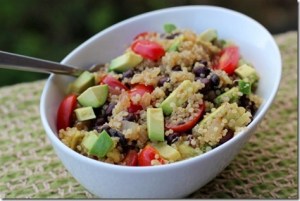
Mexican Quinoa with Black Beans and Avocado

Ingredients:  (4 servings)

1 cup dry quinoa, rinsed
2 tbsp coconut oil, divided
1 large white onion
10 medium button or Crimini mushrooms, diced
1 can black beans, rinsed and drained
1-pint cherry tomatoes, halved
2 small avocados, peeled and diced
2 tbsp lime juice (or more to taste)
salt to taste

Instructions:

Start by cooking quinoa in either a rice cooker or on the stove top. Add 1-cup dry quinoa (rinsed) to 1.75 cups of water, cover and simmer for 20 minutes or until cooked. Add 1 tbsp coconut oil to the quinoa pot for extra flavor!

Meanwhile, dice the onions and mushrooms and cook over medium heat until lightly browned, and all moisture has cooked out of the mushrooms.

Once the quinoa has finished cooking, add fluffed quinoa and black beans to the pan with mushrooms and onions, and stir to combine and heat through.

Add 2 tbsp lime juice (or more to taste), and reduce heat to low.

Stir in sliced cherry or grape tomatoes and avocado, and season to taste with salt.

Serve with tortilla chips and a dollop of Greek yogurt, and enjoy!

With the double dose of black beans and quinoa, this dish packs a huge nutritional punch of making a complete protein.  Perfect for vegetarians and vegans, but tasty and simple enough to make anyone clean their plate.

P.s. I found this recipe on Daily Garnish, check it out, she’s got some smart ideas.


Leave a comment

Cherries!

Yummy, but don't eat too many!

I really like cherries. The other day I got to thinking about cherries and why they crack sometimes after you rinse them. I know that the crack is no a big deal but it looks gross, so I either toss the cherry, or cut off the crack and eat the rest. Yea, I know it’s ridiculous.  Anyway, I decided to look into the cherry cracking matter, here’s what I found.

Basically a cherry has a skin (they call it membrane, but I don’t like that word) that covers the fruit. Evidently, during the late stage of development, there’s an explosive increase in growth, the size of the cherry increases at a rate of one square centimeter (a sixth of a square inch) per day, which is a large rate of growth in relation to the small size of the fruit. Apparently, the insides of the fruit grows really fast but the outside skin remains the same size and is expected to stretch to cover the inside fruit (like a balloon filling with air). When the cherry gets wet, it puts a strain on the skin, and sometimes it cracks. Very interesting, don’t you think?

Since we’re talking cherries, here are a few tidbits you might like.

  • Washington State produces more than 50% of all the sweet cherries in the United States. Washington cherry season is June – August
  • The Rainier cherry, is yellow with a red blush, was made from a cross between two dark red cherries, the Van and Bing
  • Each American eats approximately 2.6 lbs. of cherries per year and there are approximately 53-pitted cherries in one pound of cherries (I have already eaten my quota!).
  • One cherry has 5 calories. One cup contains about 90 calories and 3 grams of fiber.
  • Cherries are a good source of vitamin C.

Personal lessons from Kelley

  • Watch that you don’t eat too many cherries. Remember, they’re high in fiber, which can be dangerous (get where I am going with this?). Trust me.
  • Cherry juice stains your fingers and cloths. Just so you know.

Enjoy!


2 Comments

Coconut Water, not just for the shipwrecked anymore

Coconut Water

A couple of years ago my coach at the time suggested I try drinking 100% coconut water to rehydrate after a hard workout. Sadly at the time his words went in one ear and out the other. Now, years later I’m finding that the cloudy liquid inside a coconut has become highly popular and is currently all the rage.

Basically, coconut water contains more potassium than most sports drinks along with a huge list of other impressive claims: it cleanses your digestive tract, fights viruses like Herpes and AIDS, raises your metabolism and I even saw some data that suggested that it promotes hair growth (soak your bald head with it).

In the end, 100% coconut water is a naturally refreshing drink full of electrolytes. Use it to rehydrate after an intense workout. I think it tastes pretty good, although my friend Jacks thinks it tastes like “toilet water.” My suggestion to her was put it in the blender with some frozen fruit and whip up a post workout smoothie. Try it with frozen banana chunks, strawberries, add some yogurt, whatever floats your boat.

What the heck…give it a try, I’m glad I finally did.